Jane Austen: names and notability
Early printed books on display at the British Library to mark the 250th anniversary of Jane Austen's birth reveal her first steps from anonymity to literary immortality.
2 December 2025Early printed books on display at the British Library to mark the 250th anniversary of Jane Austen's birth reveal her first steps from anonymity to literary immortality.
2 December 2025Blog series English and drama
Author Francesca Cioni, Curator of Printed Heritage Collections
December 2025 sees Jane Austen’s 250th birthday. Today, Austen (1775-1817) is known as one of Britain’s most enduringly popular authors, translated into dozens of languages and frequently adapted for stage and screen. But this was not always the case, as Austen never published works under her own name during her lifetime. In the Treasures Gallery you can now see some early editions of her works, which trace her first steps from anonymity to literary immortality.
Austen’s earliest published novel, Sense and Sensibility, was first printed in 1811, identified on the title page as 'by a Lady'. All Austen tells us about herself is that she is a woman, and a well-born one at that. Perhaps this is a sign of reticence or modesty, or perhaps she is marking herself as part of a tradition of anonymous female writers including Maria Edgeworth and Fanny Burney, both of whom Austen read and admired.
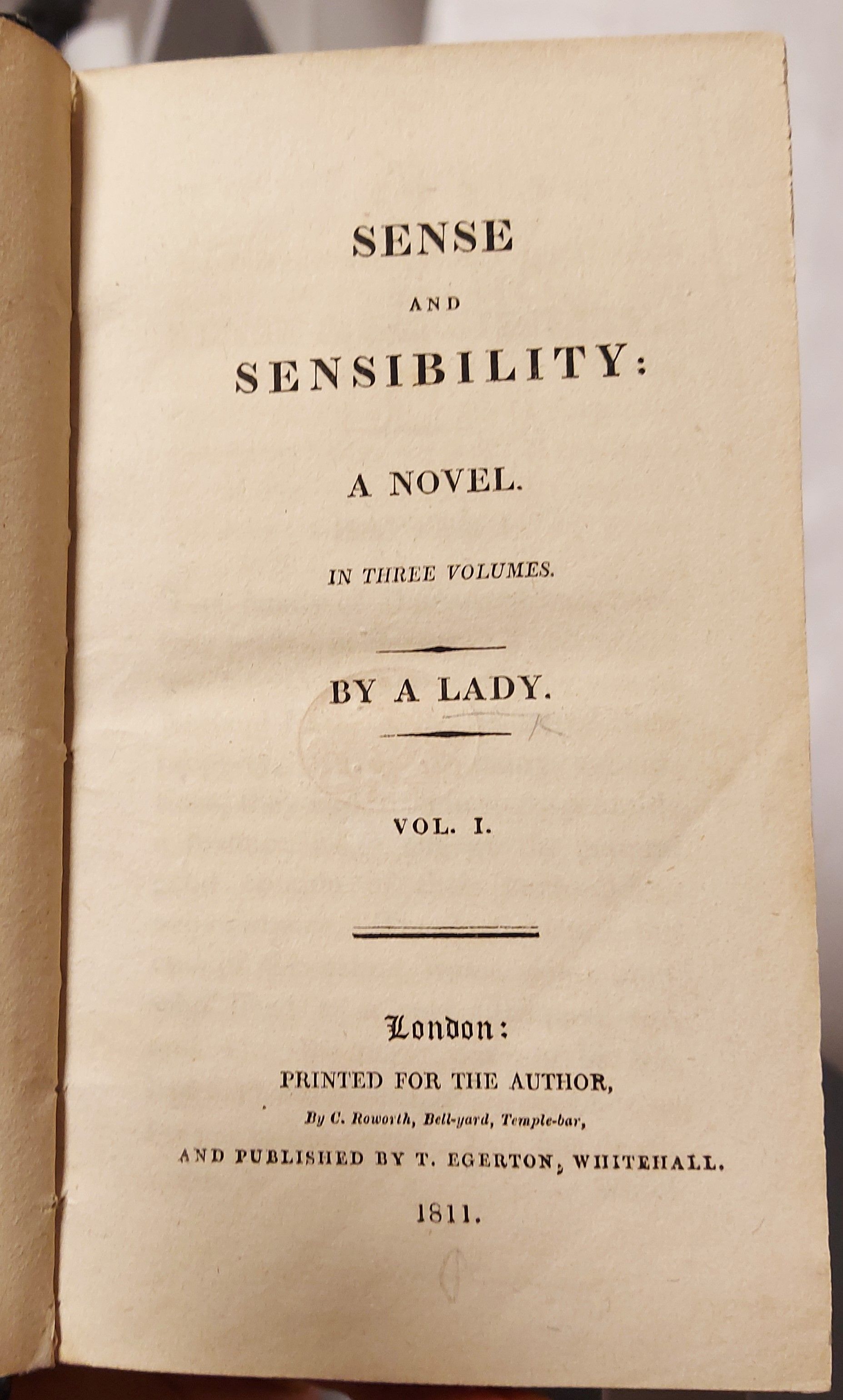
The title page of the first printed edition of Sense and Sensibility, identifying the novel as 'by a Lady'.
Subsequent publications explicitly connected Austen with her previous works: 1814’s Mansfield Park, for example, is 'by the author of "Sense and Sensibility", and "Pride and Prejudice"'. Also on display is a July 1813 letter from Jane to her brother Francis, which sees her jubilant at the success of these novels, which had together earned her £250. This title-page identification shows us an author who, while anonymous, is nonetheless crafting a canon of her own work.
It was not until the posthumous publication of Northanger Abbey: and Persuasion in 1818 that Austen was named publicly. Not on the title page – here she is still 'the author of "Pride and Prejudice", "Mansfield Park", &c.'. – but in a prefaced biographical note by her brother Henry, identifying Jane and describing her 'life of usefulness, literature and religion'.
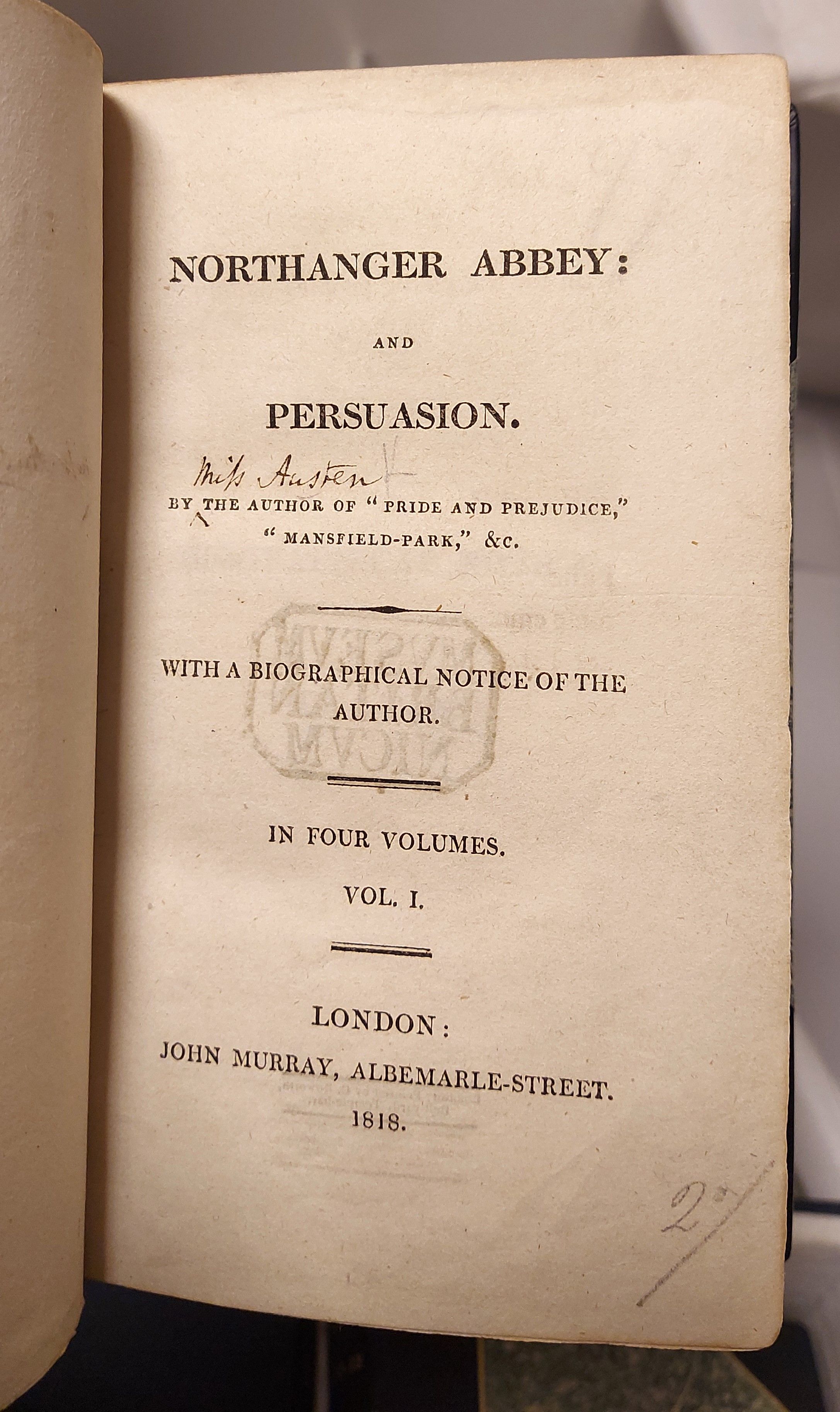
Title page of Northanger Abbey: and Persuasion, published in 1818. An earlier owner has added 'Jane Austen' by hand to the statement 'by the author of "Pride and Prejudice", "Mansfield Park", &c.'
Henry describes Jane as reluctant to commit her works to print – despite her popularity, 'so much did she shrink from notoriety, that no accumulation of fame would have induced her, had she lived to affix her name to any productions of her pen.' However much she may have shied public attention, Henry tells us, Jane deserves it for her personal virtue and her literary gifts.
But how much of this is accurate to Austen’s true intentions? The biographical notice is, after all, immediately followed by an 'Advertisement by the authoress', describing the attempts Austen herself made to get Northanger Abbey published 15 years earlier: 'This little work was finished in the year 1803, and intended for immediate publication. It was disposed of to a bookseller, it was even advertised, and why the business proceeded no farther, the author has never been able to learn.’ By her own words, Austen pursued her works' publication vigorously. Perhaps we cannot accept Henry’s portrait of modest reticence uncritically.
Nonetheless, Henry's biography set the tone for Jane’s reputation over the following decades: the humble personality and provincial society that circumscribed her life fuelling her shrewd wit and generously empathetic observation. By the end of the century, Austen's popularity and esteem were well-enshrined and reflected by publications like George Allen’s 1894 Pride and Prejudice. This was the first fully-illustrated edition, with head- and tailpieces, ornamental initials and illustrations by the artist Hugh Thomson. Its lavish title page, featuring a gilt peacock, made the edition a coveted collector’s item.
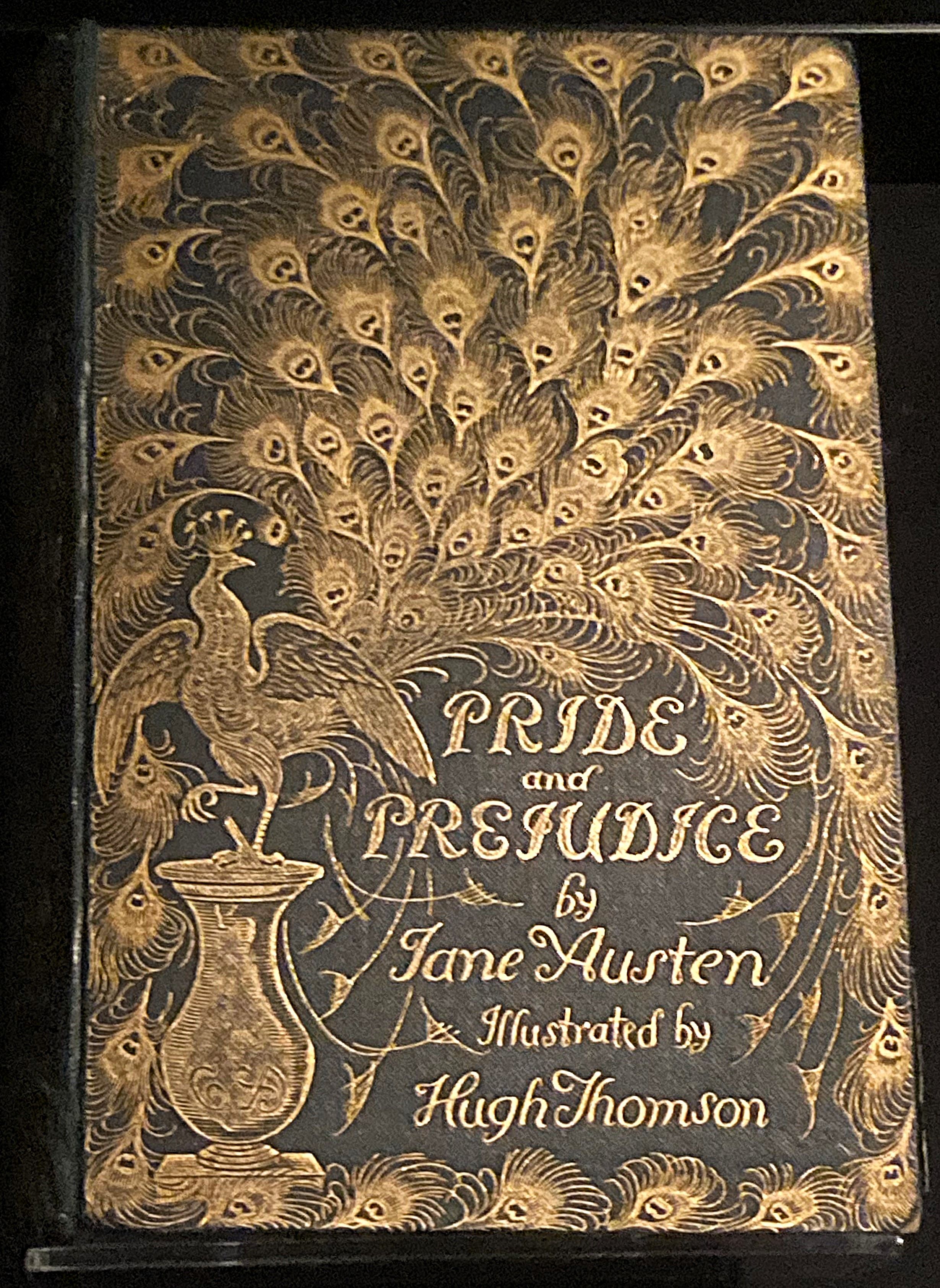
Front cover of an edition of Pride and Prejudice.
For Austen fans who covet a collector’s item of their own, the British Library is proud to have produced a faithful facsimile of the first edition (1813) of Pride and Prejudice. The beautiful three-volume novel comes with an introductory booklet and facsimiles of three of Jane Austen’s letters from our Manuscript collection.
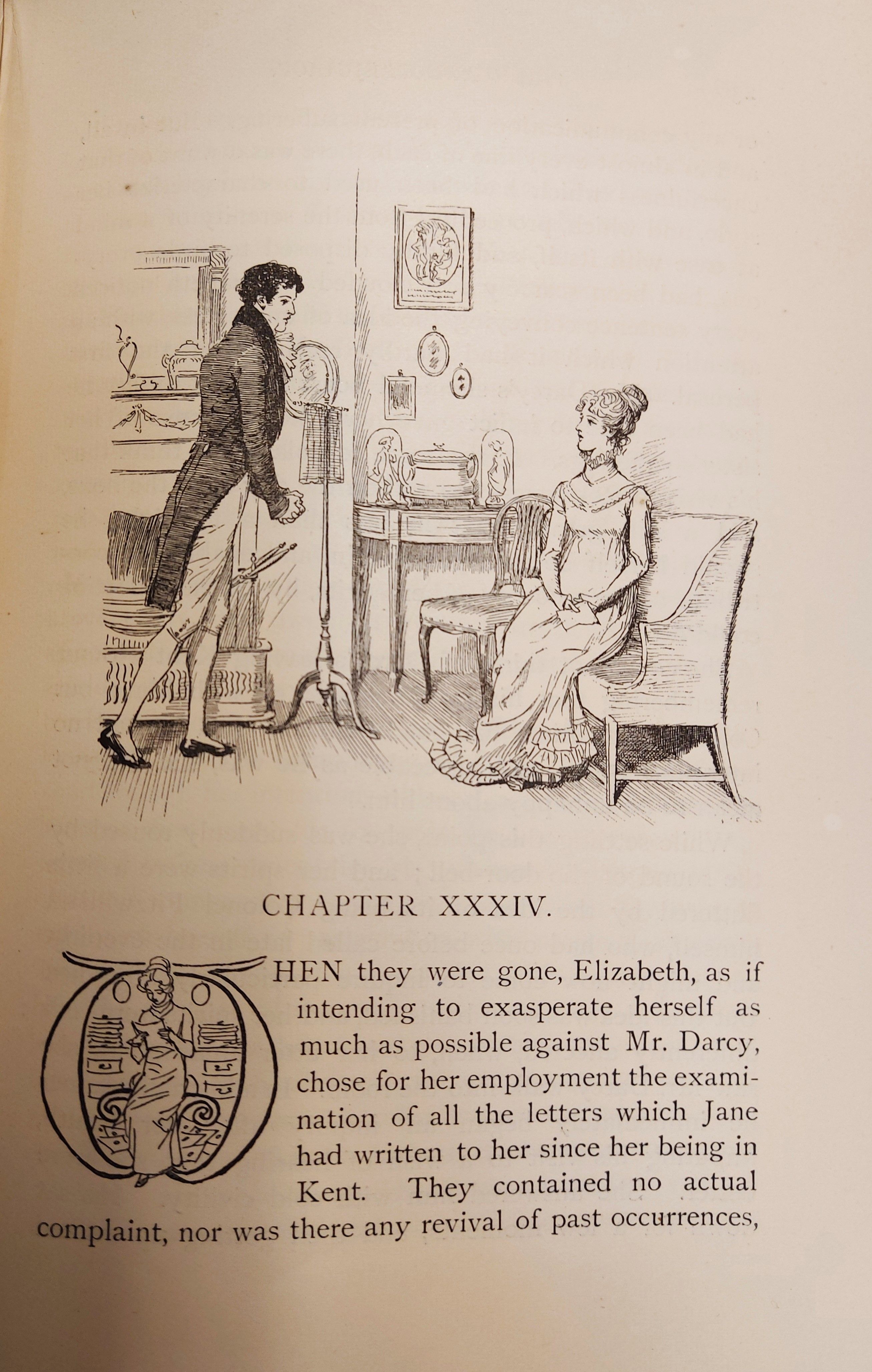
The beginning of Chapter 34 of Pride and Prejudice, from George Allen's 1894 illustrated edition of the novel. It features a headpiece illustration by Hugh Thomson depicting Elizabeth and Mr Darcy.
Sense and Sensibility : a novel. London: printed for the Author... and published by T. Egerton, Whitehall, 1811. C.71.bb.14.
Pride and Prejudice : a novel. London: George Allen, 1894.
Northanger Abbey : and, Persuasion. London: John Murray, 1818 (December 1817). Cup.403.bb.13.
Jennie Batchelor, ‘Anon, Pseud and ‘By a Lady’: The spectre of anonymity in women’s literary history’, in Jennie Batchelor and Gillian Dow, eds., Women’s Writing, 1660-1830: Feminisms and Futures. London: Palgrave Macmillan, 2016), pp. 79-96.
Dierdre Le Fay, ed. Jane Austen’s Letters. Fourth edition. Oxford: Oxford University Press, 2011.
Claire Tomalin, Jane Austen: A life. London: Viking, 1997.
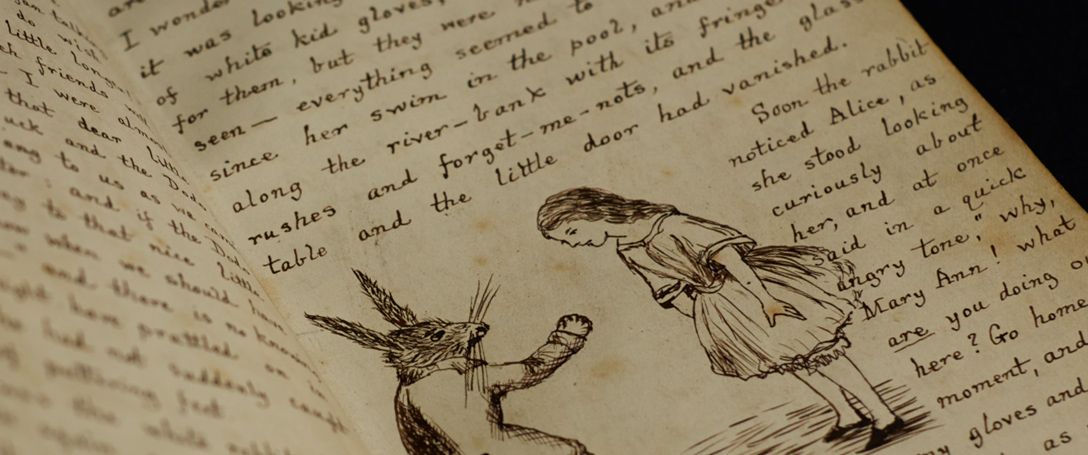
Discover more about our literature and theatre collection from the 16th century to the present day.
Explore the British Library's collection of over 170 million items, such as books, manuscripts, newspapers, maps, sound recordings, photographs and digital resources