Keeping a cat and other rules for anchoresses
A glimpse into the daily lives of medieval anchoresses, shaped by strict rules of prayer, seclusion and devotion.
29 October 2024A glimpse into the daily lives of medieval anchoresses, shaped by strict rules of prayer, seclusion and devotion.
29 October 2024Blog series Medieval manuscripts
Author Calum Cockburn
Our past exhibition Medieval Women: In Their Own Words highlighted the stories of women across medieval society, from labourers and artisans to abbesses and queens. Some of the most unique experiences were had by anchoresses, religious women such as Julian of Norwich (d. after 1416), Christine Carpenter (fl. 1329-1332) and Margaret Kirkby (d. c. 1391-4), who chose to enclose themselves permanently in cells attached to churches. There they lived lives of prayer, contemplation and devotion to God.
Several surviving texts provide guidance to anchoresses about how to live their lives. One handbook, known as Ancrene Wisse, was composed in the first decades of the 13th century, supposedly for three sisters who had chosen to enter the contemplative life.
One of the earliest and most important surviving manuscripts of this text (Cotton MS Cleopatra C VI) was on display in the exhibition. The Middle English work not only offers anchoresses spiritual advice, but also practical instructions about all aspects of their daily routine, outlining the rules they are expected to observe, from their food and drink to their clothes and possessions, and even the pets they could own.

The earliest surviving manuscript of Ancrene Wisse; England, c. 1225-1230: Cotton MS Cleopatra C VI, f. 193r
Here is a selection of these rules that give a taste of what life as an anchoress might have looked like:

The enclosure of an anchoress by a bishop; London, 15th century: Lansdowne MS 451, f. 76v

An anchoress inside her anchorhold; London, c. 1400-1410: Cambridge, Corpus Christi College, MS 079, f. 96r

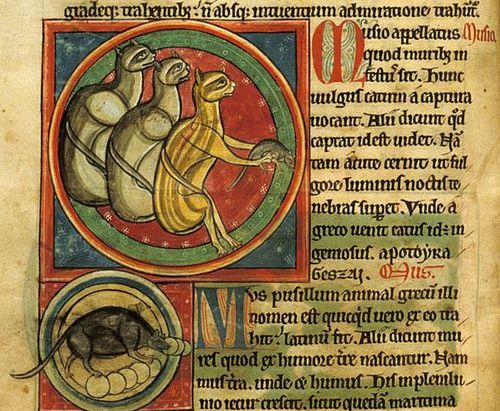
The only animal an anchoress was allowed to keep was a cat: Add MS 42130, f. 190r
Ancrene Wisse was one of the more popular medieval anchoritic handbooks – at least 17 manuscripts of the text survive, with translations in Middle English, Anglo-Norman French and Latin – but whether these rules represented a reality for all anchoresses is difficult to judge. There may have been other advisory texts available to guide them, some less stringent than others.
One can also imagine the individual relationships anchoresses had with their communities meant that a life of restriction and near-total seclusion was harder to adhere to. Nonetheless, the rules Ancrene Wisse sets out give us a sense of what these women were knowingly committing to when then entered the contemplative life.
This blog is part of our Medieval manuscripts series, exploring the British Library's world-class collections of manuscripts – including papyri, medieval illuminated manuscripts and early modern state papers.
Our Ancient, Medieval and Early Modern Manuscripts series promotes the work of our curators, who are responsible for these items and thousands more.
Discover medieval historical and literary manuscripts, charters and seals, and early modern manuscripts, from Homer to the Codex Sinaiticus, from Beowulf to Chaucer, and from Magna Carta to the papers of Henry VIII and Elizabeth I.
Explore the British Library's collection of over 170 million items, such as books, manuscripts, newspapers, maps, sound recordings, photographs and digital resources