Margaret Kirkby, a medieval anchoress
A manuscript recently acquired by the British Library contains an influential religious work dedicated to a medieval anchoress, Margret Kirkby, and is now on display in the Treasures gallery.
31 December 2025A manuscript recently acquired by the British Library contains an influential religious work dedicated to a medieval anchoress, Margret Kirkby, and is now on display in the Treasures gallery.
31 December 2025Blog series Medieval manuscripts
Sometime in the 1300s, a young nun from Yorkshire asked the local hermit for spiritual advice. Her name was Margaret Kirkby, from the parish of Kirkby Ravensworth, in the North Riding. He was Richard Rolle (died 1349), who is renowned as one of the most influential religious authors from medieval England.

Abbey Cottage sits on the former site of Hampole Priory, where Margaret Kirkby lived in her early and later years. CC BY-SA 3.0 JohnArmagh
In response to Margaret’s request, Richard Rolle composed a guide for recluses, in Middle English, known as The Form of Living. By this stage, Margaret had left the nunnery of Hampole (where Rolle was the spiritual director) and had become an anchoress at East Layton, near her place of birth, in the vicinity of modern-day Darlington and Barnard Castle. The British Library has recently acquired an important manuscript containing The Form of Living and other works composed by Richard Rolle, in a compilation entitled ‘On the contemplative life’ (Add MS 89790). The manuscript in question had formerly been in the collection of Longleat House (Longleat MS 29), and it is one of five volumes purchased by the Library with the support of the National Heritage Memorial Fund, the Art Fund (with a contribution from the Wolfson Foundation), The American Trust for the British Library, the British Library Collections Trust, the Friends of the Nations’ Libraries, and other donors.
Most significantly, this is the only manuscript in which Rolle’s works are dedicated explicitly to Margaret Kirkby, thus providing key evidence of their close professional relationship. The Oxford Dictionary of National Biography even goes so far as to describe this as ‘a platonic Yorkshire love story that anticipates Wuthering Heights’ (Hughes, 2004).

The opening page of Richard Rolle’s ‘On the contemplative life’, with the dedication to Margaret Kirkby: Add MS 89790, f. 30r.
On the page shown here, the red heading to the text (the rubric) reads, ‘Tractatus Ricardi heremite ad Margaretam de Kyrkby reclusam de vita contemplatiua’. At the time of writing (December 2025), visitors to the Library’s Treasures Gallery can also view the page in question, where it is on display in the cases devoted to medieval and modern literature, sitting snugly between Beowulf and Shakespeare’s First Folio. The entire manuscript can also be viewed online.
The inclusion of Margaret Kirkby’s name is not the only interesting feature of this volume. Most unusually for a Middle English literary manuscript, it is written in the Hiberno-English dialect used in medieval Ireland. Based on the handwriting, we can deduce that the manuscript was written by a scribe named Nicholas Bellewe, probably in the 1420s or 1430s. Bellewe is known to have been active in Dublin between 1428 and 1475, and from 1433 to 1445 he worked for the Fitzwilliam family. In all likelihood, this volume was made for a female patron who lived in the vicinity of Dublin.
In addition to the works of Richard Rolle, Add MS 89790 contains other devotional texts that would have appealed to female readers, including what is the oldest and most complete copy of A Revelation of Purgatory, describing a series of visions experienced by an anchoress in Winchester in 1422. Other texts in this manuscript are Geoffrey Chaucer’s A Parson’s Tale (part of his Canterbury Tales) and works by the spiritual authors Walter Hilton and William Fleet.

This manuscript also contains A Revelation of Purgatory, one of the most important devotional texts composed by a medieval English woman: Add MS 89790, f. 155r.
In the 1380s, Margaret Kirkby returned to the nunnery at Hampole. Guided by the teachings of Richard Rolle, she had devoted herself to spiritual contemplation. In her earlier life, she had suffered seizures, and Rolle had allowed her to sleep on his shoulder at the window of her anchorage. She died in the 1390s, and was buried in the cemetery at Hampole, near the body of Richard Rolle himself.
Hughes, J. (2004) 'Kirby, Margaret', Oxford Dictionary of National Biography. Available at https://doi.org/10.1093/ref:odnb/57764 [subscription login required].
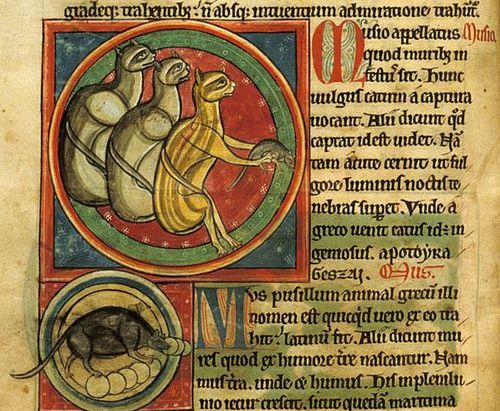
This blog is part of our Medieval manuscripts series, exploring the British Library's world-class collections of manuscripts – including papyri, medieval illuminated manuscripts and early modern state papers.
Our Ancient, Medieval and Early Modern Manuscripts series promotes the work of our curators, who are responsible for these items and thousands more.
Discover medieval historical and literary manuscripts, charters and seals, and early modern manuscripts, from Homer to the Codex Sinaiticus, from Beowulf to Chaucer, and from Magna Carta to the papers of Henry VIII and Elizabeth I.
Explore the British Library's collection of over 170 million items, such as books, manuscripts, newspapers, maps, sound recordings, photographs and digital resources