Skip to content

10 things you didn’t know about the Red Book of Bath

The British Library recently acquired an incredible medieval manuscript known as the Red Book of Bath. We’ve given it the shelfmark Add MS 89789. Here are some things you may not know about it.

23 March 2026

Blog series Medieval manuscripts

1. It’s red

Well, technically more a reddish-pink. Its medieval chemise (the leather cover) was originally dyed red, traces of which can still be seen inside the cover. You can view the book in full online.

2. It’s from Bath

The Red Book was made for the mayor and other officials in order to administer trade and justice in the town. It’s the most important surviving compilation of its kind from any medieval English town or city.

3. It retains its medieval binding

It has the original oak boards, and inside the upper cover is a hinged metal door, which once housed a set of scales and measures for the weighing of gold.

The inside upper board of the Red Book of Bath that has a recess for holding weights and measures: Add MS 89789, inside front cover (open).

The inside upper board of the Red Book of Bath has a recess for holding weights and measures: Add MS 89789, inside front cover (open).

4. It has an amazing connection with King Arthur

The Red Book contains a unique Life of Arthur in Middle English verse (ff. 42v–46r). In the margin of one page is a drawing of a sword labelled ‘Caliburnus’, none other than Excalibur.

A page of the Red Book of Bath with a sketch of King Arthur’s sword: Add MS 89789, f. 43r.

King Arthur’s sword: Add MS 89789, f. 43r.

5. It contains copies of Magna Carta and other legal texts

This includes the Assize of Ale and the Assize of Bread.

6. It also contains some rough-drawn maps of Italy, the eastern Mediterranean and Greece

Their purpose is uncertain, but perhaps they were added to the Red Book by a merchant who wanted to show the location of particular trading routes or the sources of their goods.

A page of the Red Book of Bath with a sketch-map of Italy: Add MS 89789, f. 69r.

A sketch-map of Italy: Add MS 89789, f. 69r.

7. It records a medieval inscription found in the ruined temple of Minerva at Bath

As noted in the manuscript on 7 December 1582 (f. 68v), this epitaph marked the burial place of Alexander de Alneto, Erneburoa {Erneburga?), his wife, and their children, grandson and great-grandson.

8. Crime and punishment

Towards the end of this manuscript is a drawing of the town’s pillory in 1412, next to a list of 24 citizens (all men) who had been sworn in as jurors.

A page of the Red Book of Bath depicting a pillory next to a list of jurors at Bath: Add MS 89789, f. 68r.

The pillory next to a list of jurors at Bath: Add MS 89789, f. 68r.

9. The bells, the bells

The Red Book of Bath contains a note on bell-ringing in the town, in 1418, and there is even a marginal drawing of a bell (f. 16v).

10. Not for the squeamish

One of the mayors of Bath or someone in his entourage had an interest in medicine. On one page there is a drawing of a blood-letting man, annotated in Middle English to show the appropriate parts of the body. For example, to relieve sickness in the head, stomach, heart or spleen, blood should be let from points around the left elbow.

A page of the Red Book of Bath with the drawing of a blood-letting man: Add MS 89789, f. 13r.

The drawing of a blood-letting man: Add MS 89789, f. 13r.

The Red Book of Bath (Add MS 89789) was purchased by the British Library from the Trustees of the Longleat House and Chattels Settlement in 2025. It was acquired with the support of the National Heritage Memorial Fund, the Art Fund (with a contribution from the Wolfson Foundation), The American Trust for the British Library, the British Library Collections Trust, the Friends of the Nations’ Libraries, and other donors.

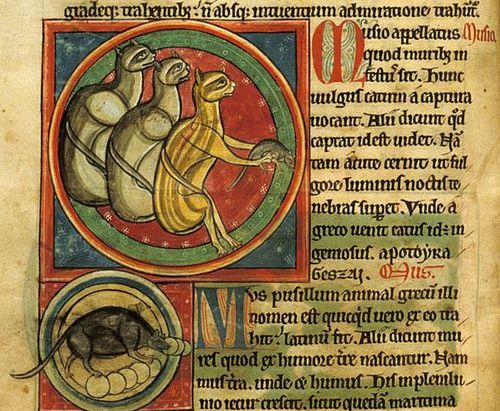
A page from a 13th-century bestiary, showing illustrations of cats and mice.

Medieval manuscripts series

This blog is part of our Medieval manuscripts series, exploring the British Library's world-class collections of manuscripts – including papyri, medieval illuminated manuscripts and early modern state papers.

Our Ancient, Medieval and Early Modern Manuscripts series promotes the work of our curators, who are responsible for these items and thousands more.

Discover medieval historical and literary manuscripts, charters and seals, and early modern manuscripts, from Homer to the Codex Sinaiticus, from Beowulf to Chaucer, and from Magna Carta to the papers of Henry VIII and Elizabeth I.

10 things you didn’t know about the Red Book of Bath