'Home' in the imagination of the immigrant
How can visual works by immigrant artists inform the depiction of characters in immigrant narratives?
26 May 2026How can visual works by immigrant artists inform the depiction of characters in immigrant narratives?
26 May 2026Blog series Americas and Oceania
Author Zeus Sumra is a 2025 Eccles Institute Visiting Fellow based at Hollins University in the United States.
Althea McNish was part of a wave of Caribbean immigrants who arrived in the U.K., in the wake of the Second World War, mostly in the 1950s and 1960s. Many prominent artists and public figures, McNish included, emerged from that cohort of migrants, and then went on to form the Caribbean Artists Movement (CAM). With artistic contributions as well as the social movements they inspired, members of CAM radically influenced the culture and politics of their adoptive country.
Born in Trinidad in 1924, McNish would go on to have a remarkable career, becoming Britain’s leading textile artist of Afro-Caribbean descent. McNish is best known for fabrics, upholstery, and other kinds of textiles featuring patterns and designs that are inspired by the flora and fauna of her native country. Many of her designs were issued in multiple colorways, and it is this foregrounding of vibrancy that made her oeuvre stand out in the oft-bleak works so common in the textile industry of postwar Britain.

McNish’s work was featured in the West Indies Chronicle (1967), LOU.260.

Daily Mail’s Ideal Home Exhibition (1966), 07943.aa.5.
She was a child possessed of spacious curiosity—her talent and intelligence apparent early on. In school, she demonstrated a deep interest in the natural world which found expression in a variety of art forms. In 1951, a year after her father had left Trinidad, McNish and her mother relocated to London so they could join him. Her parents’ support has often been credited for ensuring the early success she found as an artist. Although she had initially planned to study architecture, for which she had been awarded a prestigious scholarship, McNish decided to pursue her passion: first attending the then London School of Printing and Graphic Arts, and, after graduating, the Royal College of Art.

Tropic (1960), P.P.7615.kf.

Tropic (1960), P.P.7615.kf.
As an Eccles Fellow, I conducted research for a novel in progress. The main character, an international student from the Caribbean, is studying in New York. In one of the storylines, he is in a long-term relationship with a curator at the Brooklyn Museum who is putting on a retrospective of McNish’s work. Before arriving at the British Library, I knew the essential details of McNish’s biography, and I had some clear interests and guiding questions, along with a vague sense of how these might infuse my novel with fresh insight. Fiction-making, however, by its very nature, is discursive, as unpredictable as it is exciting, and the archive does not always co-operate with the guardrails of fixed plans. Guided by the creative methodologies of fiction writers whose works drew inspiration from the archive (Hilary Mantel, Edward P. Jones, Han Kang), I sought to remain receptive to what useful findings I might happen upon. I was hopeful that unexpected details about McNish, her artworks, and her association with CAM might help more honestly render my characters on the page.
Shortly before arriving in London, I came across images of Send Love Inna Barrel by the Jamaican artist Kelly-Ann Lindo. The installation reflects on the experiences of children affected by Windrush-era migration and uses the brown shipping barrel—a familiar object in Caribbean diasporic life—to examine the transactional dimensions of parenting across borders. In doing so, the work raises questions about silence, absence, colony, and empire. Placing McNish’s work alongside that of contemporary Caribbean artists allowed me to move beyond biography and reconsider my characters as people shaped by nostalgia, dislocation, citizenship, and the instability of self-hood that comes with residing in an adoptive country, when one’s identity is still tethered to the homeland.
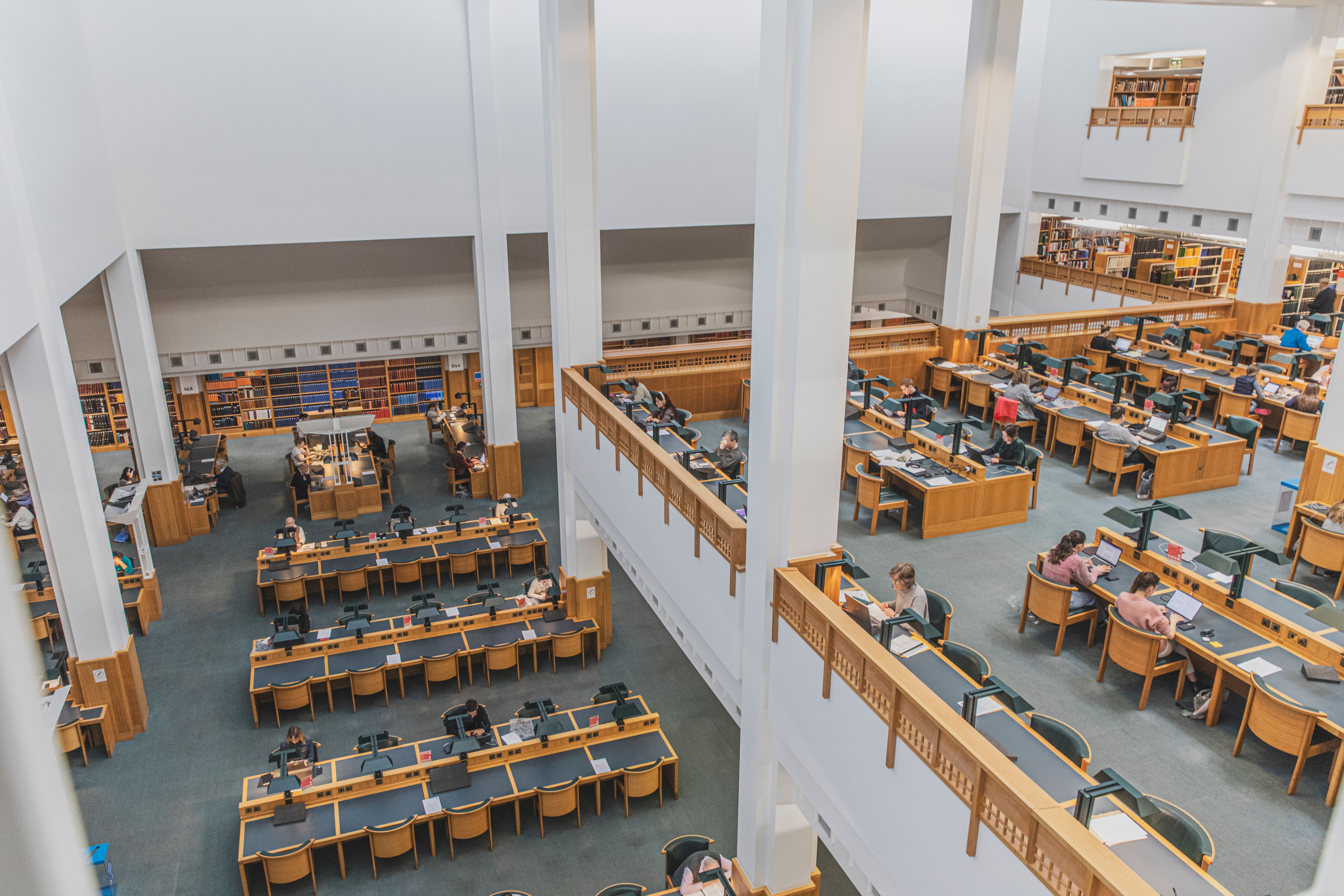
I spent most weekdays at the desks in the Reading Rooms, lit to a studious ambience, poring over back issues of now defunct magazines, such as Tropic, in which I came across a profile of McNish. The journalist included an amusing anecdote that McNish’s father had shared: no sooner had he brought in flowers for her mother than McNish would have stolen away with them to her studio. This, McNish’s persistent interest in nature, forced me to return to Golden Harvest (1957), one of her best-known works. McNish found inspiration for this piece on a visit to rural Essex. Upon seeing a field of wheat illuminated by the sun, the sight recalled scenes from Trinidad where sugarcane was set ablaze just before hand harvesting. The pattern looks as though one scene is superimposed on the other, so that the piece seemingly conveys the age-old immigrant struggle to reconcile home and abroad.

Golden Harvest (1957), one of Althea McNish’s best-known designs.
McNish was at times vague with her politics, only showing glimpses of it here and there, sometimes in her collaborations with CAM. Those glimpses made me rethink Golden Harvest as a work that merely depicts nostalgia. Rather than simply a longing for her native country, Golden Harvest can also be seen as expressing a kind of homemaking, a desire to belong, right here, in the adoptive country.
By the end of the fellowship, I had come across more evidence of how McNish’s work attends to the immigrant’s particular way of moving through the world, as an outsider, always holding up new surroundings to the memory of a home country—and I became interested in how this sense of duality can inform a more layered depiction of the immigrant experience in literature.
I am still tinkering with the novel manuscript, still considering how some of the information I have found might wend its way in. Some miscellaneous findings, I’m sure, will prove more useful in yet another creative piece. But there’s also a keen sense that the precious time spent immersed in McNish’s life and work is shaping the novel in ways I may not notice immediately, not until the book is in the hands of readers.

This blog is part of our Americas and Oceania blog series, promoting the work of our curators, recent acquisitions, digitisation projects, and collaborative projects outside the Library. Our blogs explore the British Library's extraordinarily diverse collections for the study of Americas and Oceania.
Follow us @BL_EcclesInst

Explore the British Library's collection of over 170 million items, such as books, manuscripts, newspapers, maps, sound recordings, photographs and digital resources