An Anglo-Saxon ‘Renaissance Man’: St Dunstan
Meet St Dunstan, the remarkably multi-talented Anglo-Saxon scholar, artisan and reluctant bishop.
19 May 2016Meet St Dunstan, the remarkably multi-talented Anglo-Saxon scholar, artisan and reluctant bishop.
19 May 2016Blog series Medieval Manuscripts
Author Andrew Dunning (@anjdunning)
Dunstan (d. 988), whose feast is celebrated on 19 May, was a scholar and reformer, but also a craftsman, said to have been a skilled metalworker, painter, embroiderer, musician, and even organ-builder. He was later claimed by goldsmiths, jewellers, and locksmiths as their patron saint.
The British Library collections include several delightful images of Dunstan as a bishop, though his biographers claimed that this was a role he took only reluctantly.

Miniature of St Dunstan, King Edgar, and St Æthelwold, from the Regularis Concordia, England (Canterbury?), mid-11th century, Cotton MS Tiberius A. iii, f. 2v

Miniature of St Dunstan enthroned, England (Canterbury?), c.1120, Cotton MS Claudius A. iii, f. 8r
The key source for Dunstan's life is a biography by one of his colleagues, known only by the first letter of his name, B. The British Library has digitised one of the key sources for this work, Cotton MS Cleopatra B. xiii.
Dunstan himself took a keen interest in manuscripts. He is depicted as a scribe in Royal MS 10 A. xiii, f. 2v. The Life of Dunstan in Arundel MS 16, f. 2r, which includes an initial with an image of the scribe, 'Osbearnus', being incensed, might have been a reference to this. His representation as a scribe may have had some basis in reality: the 'St Dunstan's classbook', now Oxford, Bodleian Library, MS Auct. F. 4. 32 (SC 2176), includes on f. 1r an illustration of Christ with a monk at his feet in prayer. In the thirteenth century, an inscription was added at the top of the page declaring it to be the work of Dunstan himself. Whether or not this is true, it is still thought that two lines of verse written above the monk's head are in his hand:
Merciful Christ, I ask you to defend me, Dunstan,
That you may not permit the storms of Taenarus to swallow me.
Dunstanum memet clemens rogo Criste tuere
Tenarias me non sinas sorbsisse procellas
The reference to Taenarus, the mythical entrance to the underworld, reflects the classical learning of the Anglo-Saxons (he might have picked up the reference from Ovid, Metamorphoses 10.13 or Virgil, Georgics 4.467). Some of Dunstan's own books even survive, notably the Bosworth psalter, Add. MS 37517, and a pontifical (a book containing texts of liturgical rites performed by a bishop), now Paris, Bibliothèque Nationale, MS lat. 943.
Dunstan was equally comfortable in church and court, and his earliest biographers portrayed him in close company with Kings Edmund (920/21–946) and Eadred (d. 955). As a result, he is associated with the so-called ‘Dunstan B’ charters of King Eadred, sometimes thought to have been written by Dunstan himself.

Charter of King Eadred, anticipating the ‘Dunstan B’ type, granting Reculver minster to Canterbury Cathedral, 11th century, London, British Library, Cotton Augustus ii. 57 (Sawyer no. 546)
As an artisan, however, Dunstan might have been most satisfied with his portrait in Harley MS 315, f. 15v, where he is cheerfully pinching a demon's nose with a pair of tongs.

Initial from the Life of Dunstan in the Canterbury Passionale, second quarter of the 12th century, London, British Library, Harley MS 315, f. 15v.
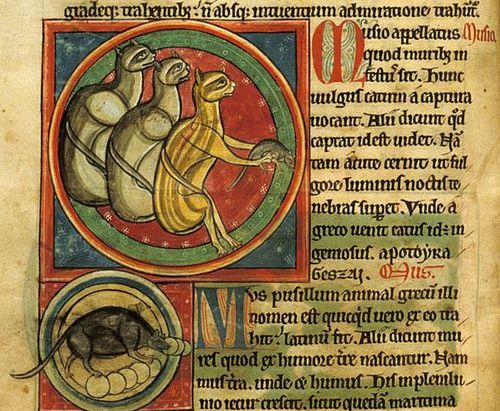
This blog is part of our Medieval manuscripts series, exploring the British Library's world-class collections of manuscripts – including papyri, medieval illuminated manuscripts and early modern state papers.
Our Ancient, Medieval and Early Modern Manuscripts series promotes the work of our curators, who are responsible for these items and thousands more.
Discover medieval historical and literary manuscripts, charters and seals, and early modern manuscripts, from Homer to the Codex Sinaiticus, from Beowulf to Chaucer, and from Magna Carta to the papers of Henry VIII and Elizabeth I.
Explore the British Library's collection of over 170 million items, such as books, manuscripts, newspapers, maps, sound recordings, photographs and digital resources